
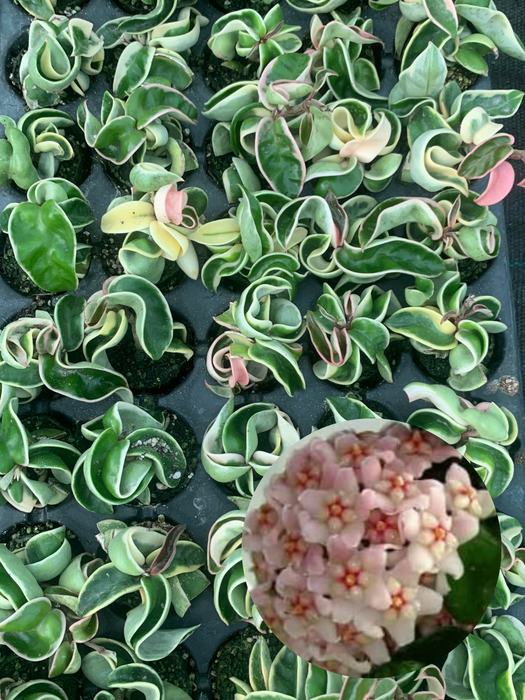
Hoya Indian Rope Variegated (Hoya Carnosa Compacta Albomarginata)
Hoya Starter Plant available for a limited time. Please note some variegated varieties show less variegation at present but all cuttings are from variegated stock.
The Hoya Indian Rope Variegated, known botanically as Hoya Carnosa Compacta Albomarginata, is one of the most sought-after collector hoyas in Australia. Its densely twisted, rope-like foliage, creamy marginal variegation, and occasional clusters of fragrant star-shaped blooms make it as functional as it is visually striking.
Quick Care Specs
|
Spec |
Detail |
|
Light |
Bright indirect light – no harsh direct sun. A filtered east- or west-facing window is ideal. |
|
Water |
Allow the top third of the soil to dry between waterings. Very drought tolerant once established. |
|
Humidity |
40-60% is ideal, though the plant tolerates average indoor humidity without complaint. |
|
Temperature |
10-25°C. Active growth is strongest between 18-25°C. Protect from frost and cold draughts. |
|
Difficulty |
Moderate. Slow-growing and undemanding once past the establishment phase. |
|
Pet Safety |
Mildly toxic to cats and dogs if ingested. Keep out of reach of animals that chew foliage. |
What Makes the Variegated Indian Rope Special
Among the many forms of Hoya Carnosa Compacta, the variegated versions occupy a league of their own. The signature tight coiling of the leaves gives the plant its distinctive rope-like appearance, but it is the added layer of cream, white, or golden patterning that elevates these specimens from houseplant to heirloom.
The variegation is genetic and stable through the stock, which means each cutting has genuine potential to develop stunning markings as it matures and grows in the right conditions.
Variegation Types: Albomarginata (Outer) vs Mauna Loa (Inner)
The two most commonly encountered variegated forms differ in where the lighter colouring appears on the leaf.
|
Albomarginata (Outer Variegation) |
Mauna Loa (Inner Variegation) |
|
In the Hoya Carnosa Compacta Albomarginata, creamy white or pale yellow patterning appears along the outer margins of each curled leaf. The fold of the leaf creates a striking light-rimmed effect against the deep green centre when the rope trails from a hanging position. |
The Mauna Loa form carries its lighter colouring in the inner portion of the leaf. This central placement tends to make the variegation more immediately visible, making it a popular choice for collectors who want maximum contrast on their Hindu rope hoya. |
Growth Differences – Slower Due to Reduced Chlorophyll
Variegated forms of the Indian rope hoya grow more slowly than their fully green counterparts, and this is entirely expected. The light-coloured areas of each leaf contain less chlorophyll, meaning the plant produces energy less efficiently and allocates growth resources more carefully. This slower pace is part of what makes variegated specimens so collectible, where each inch of new growth feels genuinely earned.
Flowers & Fragrance
The Indian rope hoya flower is a spectacle unlike almost anything else in a houseplant collection. Each bloom cluster, known as an umbel, holds up to 50 individual star-shaped flowers with pale pink petals and a waxy, porcelain-like centre. The scent is deep, warm, and faintly chocolatey, most noticeable in the evening hours. Clusters emerge from persistent structures called spurs or peduncles, which the plant reuses to produce flowers year after year.
The Hoya Hindu rope flower tends to appear on mature, well-established plants that are slightly pot-bound, positioned in bright indirect light, and left undisturbed during the active growing season. Patience is genuinely rewarded.
How to encourage flowering:
- Let the plant become root-bound. Repotting too frequently keeps it in a vegetative growth phase. Choose a pot that fits snugly and only size up when roots are visibly escaping.
- Provide consistent bright indirect light. A position near a filtered east- or west-facing window works well. Avoid moving the plant once buds begin to form, as light changes can cause bud drop.
- Never remove old spurs. After flowers finish, the empty spur remains on the vine. New blooms will emerge from the same structure the following season, so cutting it removes a full year of floral potential.
- Allow a cooler, drier rest in winter. A slight reduction in watering and slightly cooler temperatures can act as a trigger for flowering when warmth and water return in spring.
Care Tips for Your Starter Plant
Establishing Your Cutting: Potting, First Watering, Acclimation
- Allow your cutting a day or two to acclimate to your home's light and humidity before potting.
- Use a well-draining mix: premium potting mix combined with perlite and fine orchid bark mimics the epiphytic conditions Hoya Carnosa Compacta prefers in nature.
- Choose a small pot with drainage holes. Soggy roots are the most common cause of failure in new cuttings.
- For the first watering, lightly moisten the mix rather than drenching it.
- Allow the soil to almost completely dry before watering again. This encourages the cutting to push roots outward and establish a strong foundation.
Ongoing Care: Watering, Fertilising, and Pest Checks
- Water when the top third of the soil has dried out during spring and summer.
- Feed with a balanced liquid fertiliser at half strength every two to four weeks through the growing season.
- In the cooler months, reduce watering significantly and hold off on fertilising entirely until growth resumes.
- Rotate the plant occasionally to ensure even light distribution across the trailing vine.
- Wipe the outer surface of the leaves periodically with a damp cloth to remove dust, which can reduce the plant's ability to photosynthesise efficiently.
Common Problems of the Indian Hoya Plant
|
Problem |
Likely Cause |
What to Do |
|
Yellow leaves |
Overwatering or waterlogged roots |
Allow soil to fully dry, check drainage holes are clear, and reduce watering frequency going forward. |
|
Wrinkled or shrivelled leaves |
Underwatering or very low humidity |
Give the plant a thorough watering and allow it to drain fully. Consider placing near a pebble tray with water to lift ambient humidity. |
|
Mealybugs in foliage |
Pests hiding in the tightly curled leaves — a known vulnerability of all compact hoya varieties |
Use a cotton bud dipped in isopropyl alcohol to remove visible pests, then treat with neem oil or insecticidal soap, paying close attention to the folded leaf crevices. |
|
No new growth |
Dormancy, insufficient light, or root-bound stress |
Move to a brighter position and check if roots are circling the base of the pot. If so, a gentle pot upgrade may be needed. |
Australian Growing Conditions
Across most of Australia, the Indian rope hoya plant performs best indoors or in a sheltered, well-lit position. Australia's intense UV and dry summer heat can cause leaf scorch and moisture loss in the curled foliage, so bright filtered light is strongly preferred over direct sun exposure.
In tropical and subtropical climates like Queensland, the plant can thrive outdoors in a shaded, well-ventilated spot year-round. In temperate zones like Victoria and NSW, a bright indoor window position produces the most consistent results. In cooler southern states, bring plants inside before temperatures drop below 10°C to avoid cold stress to the fleshy foliage.
Ideal temperature range for active growth is 18-25°C, with survival possible down to around 10°C.
Add to your cart today
Browsing for something else while you're here? Explore our full range at our online nursery in Brisbane, including collector favourites like monstera plants and Anthurium Plants, with regular new arrivals added to the collection each week.
Frequently Asked Questions
How fast does Hoya Indian Rope Variegated grow?
The variegated Indian rope hoya is among the slower-growing hoyas available, which is part of what makes it so desirable as a collector plant. Because the variegated areas contain less chlorophyll, energy production is slower and growth resources are allocated more carefully. Under good conditions, you might expect a few centimetres of new growth per month during spring and summer.
Is Hoya Indian Rope safe for pets?
The hoya indian rope is considered mildly toxic to cats and dogs if ingested and is not listed as pet-safe. Ingestion of the fleshy leaves or sap may cause mild gastrointestinal upset. It is advisable to keep the plant out of reach of animals that tend to chew foliage.
How do I get my Indian Rope Hoya to flower?
Flowering in the hoya hindu rope is most reliably triggered by a combination of maturity, root-bound conditions, consistent bright light, and a cooler drier rest in winter. Plants typically need to be at least two to three years old before they will bloom. Once buds begin to form, avoid moving the plant as any change in light direction can cause buds to drop before opening.
What is the difference between variegated and green Indian Rope?
Both are forms of Hoya Carnosa Compacta with the same tightly curled, rope-like foliage, but the variegated form (most commonly Hoya Carnosa Compacta Albomarginata) carries cream, white, or pale yellow patterning that the standard green variety does not. The green form tends to grow faster, tolerate lower light better, and is generally more resilient for beginners, while the variegated form is more prized by collectors and requires slightly more careful placement.
Can I propagate my Hoya Indian Rope cutting?
Yes, the Indian rope hoya plant can be propagated from stem cuttings once it has established and developed a healthy length of vine. Rooting typically takes four to eight weeks for variegated varieties, which root more slowly than green forms.
Shipping Information
Click HERE or the top of the page.
Freebies
Free Cuttings of your choice on orders of $60 or more. See the Collection
Discount Codes
Discount codes available on orders of $150 or more. See current discounts
MORE ABOUT ORDER POSTING
We post on Mondays and our cut-off time is Saturday 10am Brisbane time, any orders received after this time will be posted the following week. If Monday is a public holiday, we may post on Tuesdays, depending on the season, also please see our socials and main page for Christmas and Easter Holidays.
HOW WE PACK
We post semi bare rooted plants wrapped in bubble wrap, some plants are posted in their pots, depending on the species and size. We send with Australia Post Express Post or Startrack which is part of Australia Post.
COMBINED ORDERS
We can combine orders if they are not too large, either place your order and we will refund the postage cost on all but one order, or contact us for an invoice without postage, please note fast selling items may sell out before we can send you an invoice so please consider this during the buying process. Large orders may attract a second postage amount, we will contact you prior to posting.
T's & C's
All orders are subject to our terms and conditions
FAQ's
Please see our FAQ’s